


Views: 0 Author: Site Editor Publish Time: 2026-07-17 Origin: Site


Mechanical failure remains an unavoidable reality for modern industrial operations. Up to 50% of premature equipment breakdowns stem directly from severe contamination or improper lubrication. In these complex systems, seals serve as the absolute frontline defense for any rotating or linear motion assembly. Choosing an incorrect seal does not merely reduce mechanical efficiency. It guarantees accelerated wear and triggers highly disruptive, unplanned downtime. A bearing requires an impenetrable, engineered barrier to function at peak capacity. This guide delivers a comprehensive evaluation framework for maintenance engineers and procurement teams. You will learn how to specify the exact seal type required for your critical machinery. We will explore how harsh operating environments, stringent speed thresholds, and thermal constraints dictate your final engineering choice.
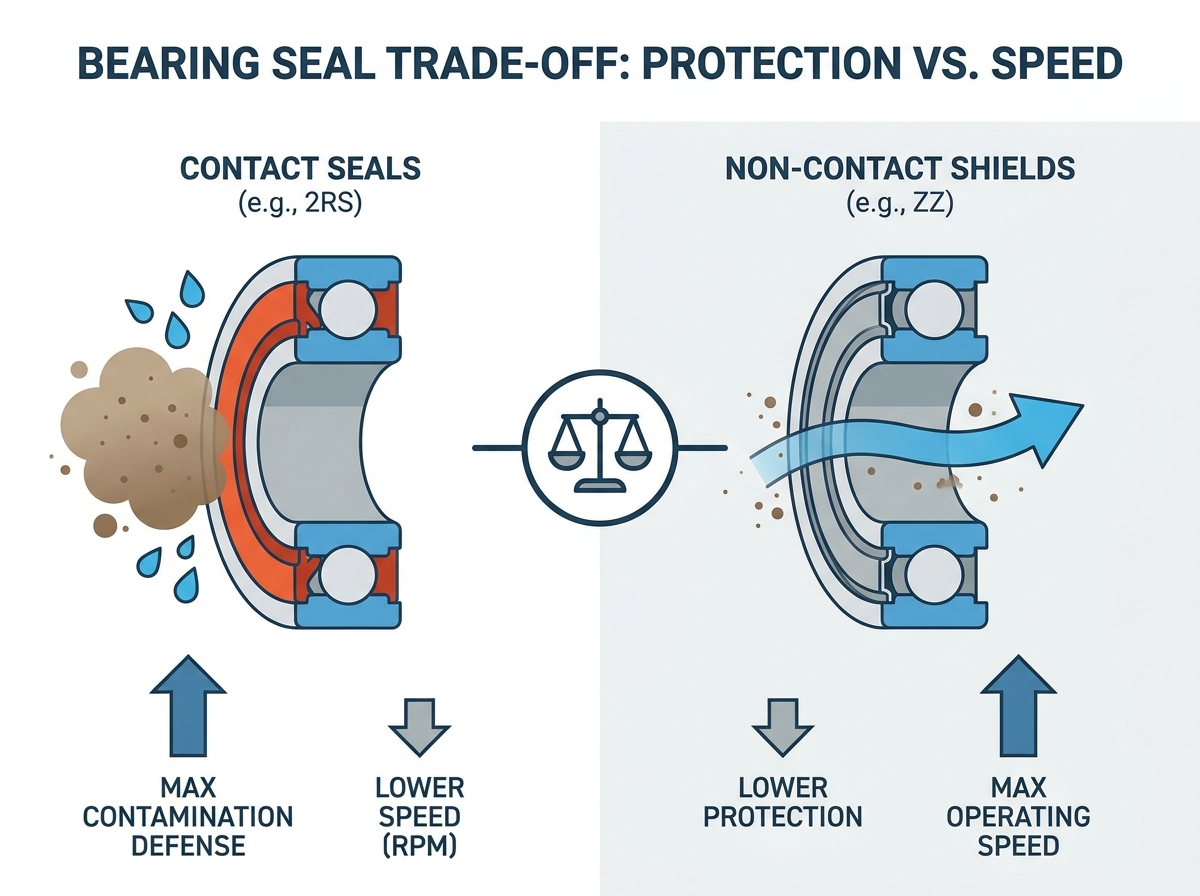
The choice between contact and non-contact bearing seals is a strict engineering trade-off between maximum contamination protection and maximum operating speed (RPM).
Upgrading seal materials (e.g., from standard NBR to FKM/Viton) extends bearing lifespan in high-temperature or chemically aggressive environments but increases initial component costs.
Linear bearing seals require specific evaluation lenses due to wiping actions and stroke lengths not present in standard rotary applications.
Standardized designations (like ZZ for shields or 2RS for rubber seals) provide a baseline, but custom sealing arrangements are often required for extreme industrial applications.
Industrial components eventually fail. When they do, the financial and operational impacts accumulate rapidly. Mean Time Between Failures (MTBF) drops significantly when machinery operates without adequate internal protection. Replacing a degraded bearing involves intensive, specialized maintenance labor. Worse, it halts active production lines completely, costing facilities thousands of dollars per minute. Reliable sealing mechanisms solve this fundamental engineering problem.
They perform three critical functions continuously. First, they retain the specified grease or oil inside the internal cavity. Proper retention maintains the hydrodynamic film necessary for smooth rolling element operation. Second, they exclude dangerous solid contaminants. Dust, metal shavings, and abrasive debris cause microscopic spalling. This spalling destroys hardened steel raceways quickly. Third, they block moisture, high-pressure washdown sprays, and aggressive chemical fluids from entering the housing.
Engineers define sealing success through careful performance balance. A properly specified barrier minimizes mechanical friction. It prevents excessive, damaging thermal buildup during continuous operation. Simultaneously, it maintains a flawless physical shield throughout the calculated fatigue life of the entire component assembly. Achieving this balance ensures long-term operational reliability.
Different environments demand specific mechanical defenses. We categorize these physical barriers into four primary groups. We base this categorization on contact dynamics, structural design, and operational intent.
Manufacturers press rigid metal plates directly into the outer ring. These plates extend inward but leave a microscopic clearance gap just above the inner ring surface.
Pros: They add zero physical friction. You can achieve maximum rotational speed. They work perfectly in clean environments.
Cons: They offer poor defense against liquids. Fine vapor and microscopic dust easily bypass the clearance gap.
These designs utilize flexible elastomer lips molded over a steel stiffening insert. The rubber lip physically rides against the rotating inner ring surface.
Pros: They deliver superior, positive protection against heavy dust, moisture, and direct fluid ingress.
Cons: Constant physical contact creates mechanical friction. This generates significant heat and strictly limits maximum operating speed.
These components utilize an advanced elastomer profile. The rubber forms an extremely tight labyrinth gap but never actually touches the inner ring.
Pros: They balance high-speed capability effectively. They provide much better contamination resistance than basic metal shields without generating excess heat.
These specialized assemblies employ complex, multi-directional clearance paths. They force contaminants to navigate a maze. Centrifugal force actively expels debris before it can reach the internal rolling elements.
Best for: Heavy industrial equipment. They excel where high speeds and extreme, heavy contamination overlap consistently.
Seal Type Designations |
Mechanical Friction Level |
Operating Speed Capacity |
Contamination Resistance Level |
|---|---|---|---|
Metal Shield (ZZ, 2Z) |
None (Clearance Gap) |
Very High (Max RPM) |
Low (Blocks large solids only) |
Contact Seal (2RS, DDU) |
High (Physical Contact) |
Low to Medium |
Very High (Blocks fluids & solids) |
Non-Contact Seal (2RZ, VV) |
None (Micro-Gap) |
High |
Medium (Blocks dust & vapor) |
Labyrinth Assembly |
Very Low |
High |
Very High (Expels heavy debris) |
Engineering teams constantly navigate complex trade-offs. The relationship between rotational speed and sealing effectiveness remains strictly inverse. Heavily sealed units must operate at lower rotational speeds. Physical contact friction generates substantial thermal energy. Excess heat degrades the internal base oil within the grease quickly. It also compromises the structural integrity of the elastomer lip itself, causing it to harden and crack.
Material selection strictly dictates environmental and temperature limits. You must match the elastomer compound directly to your operating environment.
Nitrile Rubber (NBR): This material represents the global industry standard. It remains highly cost-effective and durable. NBR handles temperature ranges from -40°C to +100°C efficiently.
Fluoroelastomer (FKM / Viton): You need FKM for high heat or aggressive chemical exposure. It survives continuous operations up to +200°C. However, it carries a higher component cost and offers much lower cold-temperature flexibility.
Teflon (PTFE): Engineers specify PTFE for extremely low friction scenarios. It also delivers exceptional, broad-spectrum chemical resistance across diverse industrial applications.
Hydrogenated nitrile rubber (HNBR): While maintaining the excellent oil resistance of NBR, it also achieves very good heat resistance (150 ℃ high temperature resistance), ozone resistance, and chemical corrosion resistance.
Torque considerations matter immensely in modern precision machinery. Contact seals increase initial starting torque significantly. They also reduce continuous running efficiency over time due to drag. Electric vehicle (EV) motors and automated robotics demand maximum power efficiency. In these precise applications, excessive seal friction drains battery power rapidly. It reduces overall system performance. You must calculate these mechanical power losses accurately during the initial design phase.
Theoretical specifications mean very little without real-world context. Different industries present unique, aggressive environmental hazards.
Food processing facilities require stringent, constant liquid protection. Equipment undergoes aggressive, high-pressure caustic chemical washdowns daily. Engineers specify FDA-compliant contact seals here. They often pair these tight seals alongside specialized solid lubricants. This strategic combination prevents grease washout completely during intense sanitation cycles.
Mining conveyors and agricultural tractors operate in brutally severe conditions. Abrasive silica dust, thick mud, and jagged rock fragments attack exposed moving parts constantly. You need heavy-duty triple-lip seals for these applications. External labyrinth arrangements also help physically block abrasive grit before it breaches delicate internal raceways.
CNC machine spindles spin at extreme, sustained velocities. They rely entirely on precision non-contact seals or standard metal shields. Contact friction would cause rapid thermal expansion across the entire spindle shaft. Thermal expansion ruins micro-level machining accuracy instantly. It produces defective, out-of-tolerance manufactured parts.
Linear guides face completely unique physical challenges. Linear seals must act as durable mechanical wipers. They must physically scrape the steel rail clean of debris during every single stroke. However, they must accomplish this aggressive wiping action without causing stick-slip phenomena. Stick-slip creates jerky, inconsistent movements. This ruins positional accuracy in automated optical inspection equipment or robotic gantries.
Selecting the perfect component requires a systematic, data-driven approach. Follow this strict four-step evaluation process to prevent premature machinery failures.
Define Operating Parameters: Document your exact performance requirements first. Note the maximum continuous RPM. Record the ambient and operational temperature ranges accurately. Specify whether the machine duty cycle is continuous or highly intermittent.
Assess Contamination Risks: Categorize your specific operating environment. Is it a highly regulated, temperature-controlled clean room? Does the facility feature moderate airborne dust? Will the equipment endure heavy fluid washdowns or highly abrasive grit daily?
Evaluate Lubrication Strategy: Determine your specific maintenance protocol. Will the unit remain sealed-for-life using factory-filled grease? Or does it require manual, periodic relubrication? Relubrication scenarios require specific seals designed to allow grease purging. Otherwise, internal hydraulic pressure will blow the rubber seal out entirely during servicing.
Mitigate Implementation Risks: Avoid over-specifying components. Paying a premium for high-temperature FKM material wastes budget if standard NBR suffices for the application. Conversely, never under-specify. Installing basic metal shields in high-moisture environments guarantees rapid internal rust and catastrophic mechanical failure.
No universal solution exists in industrial sealing technology. You must engineer the most appropriate match for your specific application. Applied loads, rotational speeds, and environmental hazards strictly dictate your final choice. Proper specification prevents unplanned downtime and maximizes component lifespan effectively.
Audit your current mechanical failure rates today. Identify recurring maintenance issues linked directly to contamination or excessive heat buildup. We recommend consulting directly with a certified engineering specialist. Access detailed technical catalogs to cross-reference spatial dimensions and sealing capabilities carefully. Making informed, data-driven decisions now will optimize your next critical machinery project.
A: Yes, provided the external spatial dimensions match exactly. However, you must carefully evaluate the operational consequences. Rubber contact seals generate physical friction. This drastically reduces the maximum allowable speed rating of the unit. They also increase heat generation. Switching to a sealed unit in a high-speed application often leads to rapid thermal failure.
A: Elastomer degradation depends entirely on your specific operating conditions. Extreme temperatures, UV/ozone exposure, and constant mechanical friction all accelerate wear. In highly abrasive or misapplied scenarios, the rubber lip often wears out long before the internal steel components fail. Regular visual inspection remains essential to ensure the physical barrier remains intact.
A: The 2RS designation indicates double-sided rubber contact seals. They provide excellent defense against fluids and heavy dust but severely limit rotational speed. The ZZ designation refers to double-sided metal shields. Shields offer zero mechanical friction and allow maximum speeds. However, they cannot block liquids or fine particle ingress.
A: No. Rotary seals remain stationary while maintaining contact against a spinning inner ring. Linear seals function as mechanical wipers. They physically scrape debris off a linear rail across long, continuous stroke lengths. Linear seals require specialized elastomer profiles to prevent stick-slip while ensuring a continuously clean travel path.