Call Us Today
Call Us Today
A Specialist on Spherical Roller Bearings Since 1969

- All
- Product Name
- Product Keyword
- Product Model
- Product Summary
- Product Description
- Multi Field Search


Views: 0 Author: Site Editor Publish Time: 2026-07-10 Origin: Site


Every modern industrial milestone relies on a continuous mechanical quest. From aerospace propulsion to automated manufacturing, we must constantly conquer friction. This challenge forms the absolute core of mechanical engineering today. While the history of the bearing spans millennia, tracing its evolution is not merely an academic exercise. It serves as a practical roadmap for modern design. You can see how this technology adapted to escalating speeds, heavy loads, and extreme environments. This historical context provides the ultimate framework for selecting the right component today. By examining the transition from basic craftsmanship to high-precision technology, engineers and procurement teams gain clear advantages. They can better evaluate current material sciences, strict compliance standards, and mechanical lifecycles. This structured approach helps you specify the exact component required for your specific application.
The evolution of the bearing maps directly to modern evaluation criteria: load capacity, friction reduction, and material resilience.
Historical standardization (e.g., ISO, ABEC) established the baseline frameworks used today to verify tolerances and ensure supply chain interchangeability.
Advancements in tribology and material science (ceramics, specialized polymers) have shifted purchasing decisions from simple dimensional matching to application-specific chemical and thermal evaluation.
Specifying modern bearings requires balancing upfront component costs against historical failure risks like misalignment, improper lubrication, and metal fatigue.
The fundamental challenge in mechanical design remains completely unchanged since antiquity. Engineers must transfer loads and enable fluid motion while minimizing energy loss and physical wear. Ancient builders quickly realized sliding a heavy object across the ground required massive amounts of energy. They needed a mechanical intervention to separate two surfaces.
We see early solutions appearing in ancient Egypt, where workers placed rolling wooden logs under massive stone blocks. This primitive application reduced surface contact area, effectively converting sliding friction into rolling friction. The Roman Empire later advanced this concept significantly. Archaeologists discovered the remains of the Nemi ships, which featured sophisticated wooden ball-style components designed to rotate heavy platform statues. Centuries later, Leonardo da Vinci sketched caged designs intended to prevent rolling elements from rubbing against each other. His insight identified a crucial flaw in earlier models: balls rolling freely often collided, creating secondary friction.
These early historical models highlight the foundational criteria you must use for modern selection. Every mechanical system requires you to assess baseline static loads versus dynamic loads. Static loads represent the force applied when equipment remains stationary. Dynamic loads occur during active rotation or movement. Before you over-engineer a modern solution, you must clearly define the precise friction and load challenges inherent to your system architecture. Understanding whether your application requires high stationary support or rapid, continuous movement dictates the entire specification process.
The dawn of the Industrial Revolution forced a massive shift from custom, rudimentary designs to mass-produced mechanical components. Factories required continuous operation, and hand-carved wooden parts could no longer withstand high-speed machinery. Engineers needed standardized solutions made from durable metals.
Philip Vaughan achieved a major breakthrough in 1794. He patented the first iron ball bearing running perfectly along a dedicated groove. This design locked the rolling elements into a specific track, dramatically increasing load capacity and operational speed. As industrial applications expanded, engineers noticed different machines generated distinct types of forces. A train axle generated heavy downward force, while a ship's propeller pushed force horizontally. This realization led to the necessary divergence of types to handle specific radial loads and thrust loads.
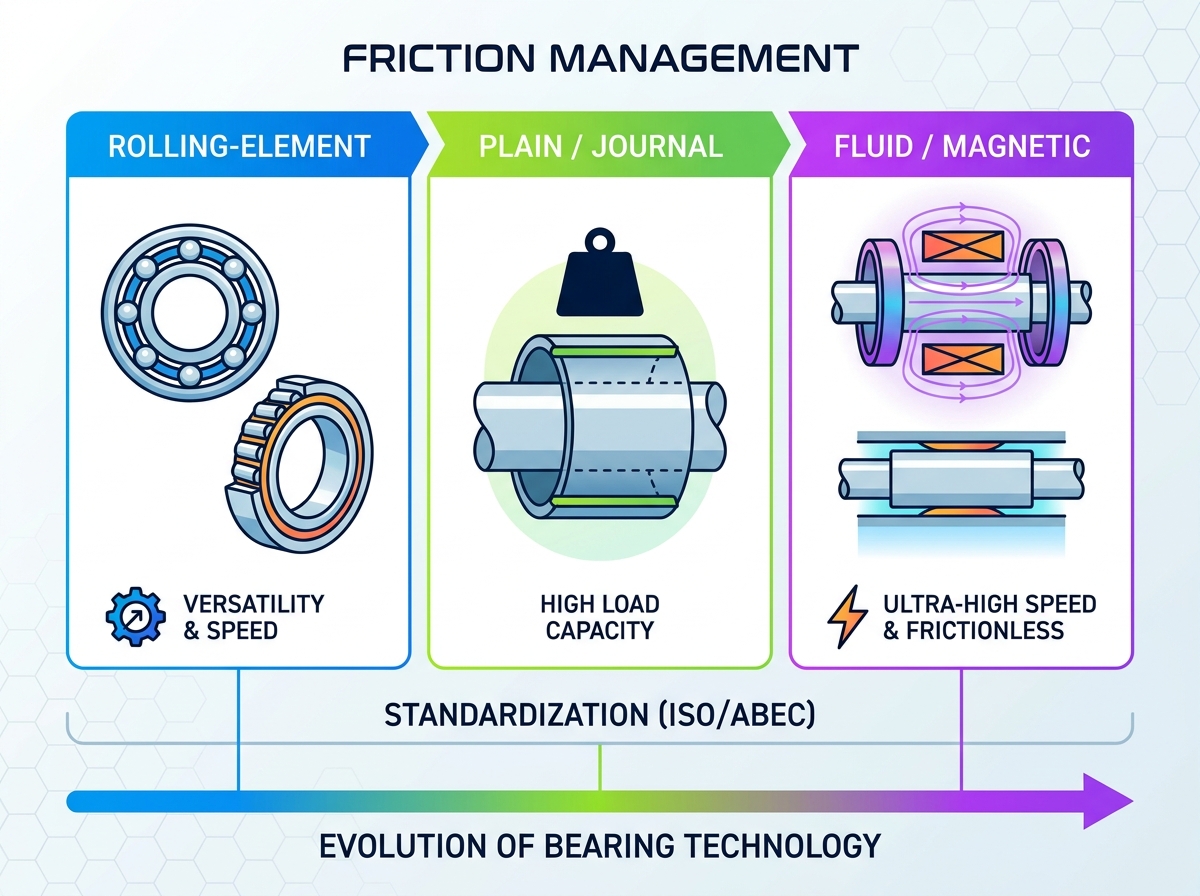
We can use this historical divergence to categorize modern solutions effectively. Using a mutually exclusive and collectively exhaustive (MECE) framework simplifies procurement strategies.
Bearing Classification Matrix
Category | Primary Characteristics | Ideal Modern Applications |
|---|---|---|
Rolling-Element | Utilizes balls, cylindrical rollers, or spherical rollers to separate races. Offers excellent speed and load versatility. | Electric motors, automotive wheels, conveyor systems. |
Plain / Journal | Lacks rolling elements. Relies on a sliding surface, often aided by hydrodynamic fluid films. | Heavy construction equipment, engine crankshafts. |
Fluid / Magnetic | Eliminates physical contact entirely using pressurized fluids or magnetic fields. | Ultra-high-speed turbines, precision aerospace gyroscopes. |
The subsequent rise of global standardization permanently changed industrial procurement. Organizations like ABEC (Annular Bearing Engineering Committee) and ISO (International Organization for Standardization) created rigid dimensional tolerances. Because of these historical standards, modern buyers can demand verifiable tolerance documentation from suppliers. You no longer have to rely on assumed specifications or inconsistent local manufacturing techniques.
As twentieth-century machinery outpaced the structural capabilities of standard steel, the industry underwent a massive evolution. Manufacturers pivoted their focus toward advanced material science and tribology. Tribology explores the interaction of surfaces in relative motion, focusing heavily on friction, wear, and lubrication.
Historically, manufacturers transitioned from simple iron and soft steel alloys to high-carbon chromium steel. This material provided the exceptional hardness required for prolonged industrial use. However, modern engineering pushes equipment into environments where even the best hardened steel fails. We now see a rapid shift toward hybrid combinations and entirely new material structures.
You must evaluate specific material features to achieve desired performance outcomes. Consider these common modern evaluations:
Ceramic and Hybrid Models: Engineers frequently evaluate these for electrical insulation. Modern electric vehicle (EV) motors generate stray electrical currents that cause pitting and fluting in standard steel components. Ceramic balls block this current entirely. They also offer a much lower centrifugal mass, allowing for exceptionally high RPMs without generating excessive heat.
Polymer and Composite Models: You evaluate these primarily for corrosion resistance and self-lubricating properties. Food-grade processing plants and intense chemical washdown environments destroy standard lubricants and corrode steel. Specialized polymers operate completely dry, preventing food contamination and resisting harsh chemical sprays.
Modern specifiers must adopt an evidence-oriented assessment methodology. You must thoroughly evaluate material certifications against actual environmental realities. Consider extreme temperature fluctuations, direct chemical exposure, or vacuum environments. Defaulting to traditional steel without auditing the operational environment often leads to catastrophic failure.
Industrial history clearly proves one harsh reality. Even the most technologically advanced component will fail if you ignore the surrounding systemic factors. A premium ceramic model cannot survive a poorly designed housing. You must mitigate external risks to ensure component longevity.
We see the same operational pitfalls repeating across decades of industrial maintenance. Understanding these historical failures helps you protect modern implementations.
Lubrication Failures: We can trace the evolution of basic animal fats to modern synthetic greases and sealed-for-life variants. Despite these advancements, insufficient or completely incompatible lubrication remains the leading cause of premature failure. Using grease intended for low-speed conveyors inside a high-speed router causes rapid overheating and immediate seizure.
Misalignment and Mounting: Proper shaft fits and housing tolerances are absolute necessities. Forcing a component onto a misaligned shaft creates immense internal stress. This uneven loading drastically reduces operational lifespans and causes severe vibration.
Counterfeit Risks: Global supply chains suffer from severe vulnerabilities. High-precision components are frequently counterfeited. Criminals stamp cheap, low-grade steel components with premium brand markings. Installing these inside critical machinery results in catastrophic, dangerous system failures.
Best Practices for Risk Mitigation:
Prioritize authorized distribution channels exclusively to guarantee product authenticity.
Mandate comprehensive Material Test Reports (MTRs) before approving vendor shipments.
Align your preventative maintenance schedules strictly with historical wear data and manufacturer guidelines.
Common Mistakes to Avoid:
Mixing different thickener types of grease, causing the lubricant base oil to separate.
Using excessive force or direct hammer blows during the mounting process, which dents the raceways.
Storing unsealed components in humid environments, allowing microscopic rust to form before installation.
You now face the challenge of synthesizing centuries of mechanical innovation into a localized purchasing decision. You need a reliable decision framework to navigate thousands of potential options.
Follow this step-by-step shortlisting logic to secure the correct component:
Define System Parameters: You must calculate your required RPM, pinpoint maximum dynamic and static loads, and define your expected operational lifespan. Engineers utilize the ISO standard L10 life calculation to predict exactly when fatigue spalling might begin.
Select the Category: You need to match the specific load type directly to the appropriate geometry. If your machine applies heavy radial forces, choose a deep groove ball design or cylindrical roller. If the machine generates heavy axial pushing forces, you must select a tapered roller or dedicated thrust model.
Specify Materials and Tolerances: Apply your strict environmental constraints to dictate the final material choice. High temperatures or strict cleanliness protocols push you toward ceramics or polymers. You also need to assign the correct ABEC precision class. Standard industrial machinery runs perfectly well on lower ABEC ratings, while aerospace instruments demand the tightest possible tolerances.
Moving from theoretical specification to real-world procurement requires definitive next-step actions. Do not rely solely on catalog descriptions. You should request detailed vendor CAD models and integrate them into your digital system assemblies. Ask suppliers for prototype samples and conduct thorough technical application reviews alongside qualified field engineers.
The history of friction management is not a static timeline found in textbooks. It remains an active, evolving catalog of mechanical problem-solving. From simple wooden craftsmanship to high-precision aerospace technology, every iteration was born from a fundamental need to improve reliability and mechanical efficiency. Today's industrial components represent the culmination of endless trial and error.
You must maintain a skeptical approach during the procurement process. No single perfect component exists in the market. You will only find the strictly engineered match for a very specific operational environment. Over-engineering wastes capital, while under-engineering causes dangerous machinery breakdowns.
We encourage readers to consult directly with application engineers today. Audit your current mechanical specifications thoroughly. Ensure your global supply chain authenticity remains unbroken. Take the necessary steps to upgrade legacy components to modern standards, ensuring your machinery operates smoothly for years to come.
A: ABEC has a total of 5 grades, ranging from low to high as ABEC-1, ABEC-3, ABEC-5, ABEC-7, and ABEC-9. The higher the number, the higher the grade and the stricter the dimensional tolerance. These strict tolerances are critical for high-speed routers or precision medical instruments to prevent vibration. However, demanding high ABEC ratings represents an unnecessary expenditure for low-speed, rugged applications like mining conveyors. Match the tolerance rating directly to your operational speed requirements.
A: You should consider hybrid or ceramic models for specific demanding use cases. Ceramics provide crucial electrical current isolation, preventing electrical pitting in modern motors. They also offer significant weight reduction, lack metal-on-metal galling, and handle exceptionally high RPM capabilities while generating much less frictional heat than steel.
A: The L10 life is an ISO standard predictive calculation. It represents the specific lifespan at which 90 percent of a given batch of identical bearings will continue to operate successfully before microscopic metal fatigue, known as spalling, occurs. It relies on the dynamic load rating and the applied equivalent load.
A: Procurement teams must buy exclusively from manufacturer-authorized distributors. You should always demand factory trace codes and material test reports. Remain highly skeptical of prices sitting significantly below the market average. Counterfeiters routinely package low-grade steel components inside convincing replica boxes to exploit unsecured supply chains.