Call Us Today
Call Us Today
A Specialist on Spherical Roller Bearings Since 1969

- All
- Product Name
- Product Keyword
- Product Model
- Product Summary
- Product Description
- Multi Field Search


Views: 0 Author: Site Editor Publish Time: 2026-07-07 Origin: Site


Improper lubrication is rarely just a minor maintenance hiccup. It acts as a primary driver of catastrophic machine failure. It causes massive unplanned operational downtime. Plant managers often discover this harsh reality only after critical operations grind to a sudden halt. Most industrial facilities try to follow an established lubrication schedule. However, many teams rely heavily on legacy assumptions. These outdated maintenance practices simply do not hold up today. They fail under modernized, high-speed, or extreme-load operating conditions. As global production demands intensify, relying on old habits becomes a significant operational liability. This guide serves as a pragmatic evaluation framework. We designed it for reliability engineers, plant managers, and procurement teams. You will learn how to audit your current strategy effectively. We will help you identify hidden vulnerabilities in your plant. We will also explore how to shortlist new product categories. Finally, you will learn how to confidently transition to automated systems.
Up to 80% of premature bearing failures are traced back to lubrication errors, specifically incorrect volume, improper selection, or cross-contamination.
Selecting the right bearing lubricant requires matching base oil viscosity, thickener compatibility, and additive packages to specific environmental and operational loads.
Transitioning from manual to automated lubrication systems requires structured ROI evaluation, factoring in labor costs, reduced waste, and equipment lifespan.
When evaluating lubricant suppliers, prioritize transparent technical data (compliance, chemical compatibility) and post-sale support over baseline unit cost.
Equipment failure carries a remarkably steep price tag. When a bearing fails prematurely, you pay for much more than just a replacement component. You must immediately factor in emergency overtime labor rates. Expedited shipping for heavy replacement parts adds massive fees. More importantly, you lose incredibly valuable production revenue. Every minute of unplanned downtime destroys your daily profit margins. Secondary damage often occurs when a rotating component locks up. Shafts bend, belts snap, and motor windings burn out rapidly.
A successful lubrication strategy flips this reactive dynamic completely. You achieve highly predictable maintenance intervals across the plant. You optimize grease consumption, eliminating expensive waste. Ultimately, you hit zero unplanned downtime related to mechanical friction. Achieving this requires a fundamental shift in mindset.
Many maintenance teams still cling to a very dangerous myth. They genuinely believe grease is just grease. This outdated assumption creates massive hidden liabilities. Relying on basic multi-purpose lubricants for highly specialized applications guarantees eventual failure. High temperatures and heavy shock loads quickly destroy generic grease formulations. For example, using standard lithium grease in a high-temperature curing oven causes rapid carbonization. The grease bakes into a hard solid. You must actively match chemical properties to physical demands. Treating lubricants as highly engineered assets changes your entire reliability culture.
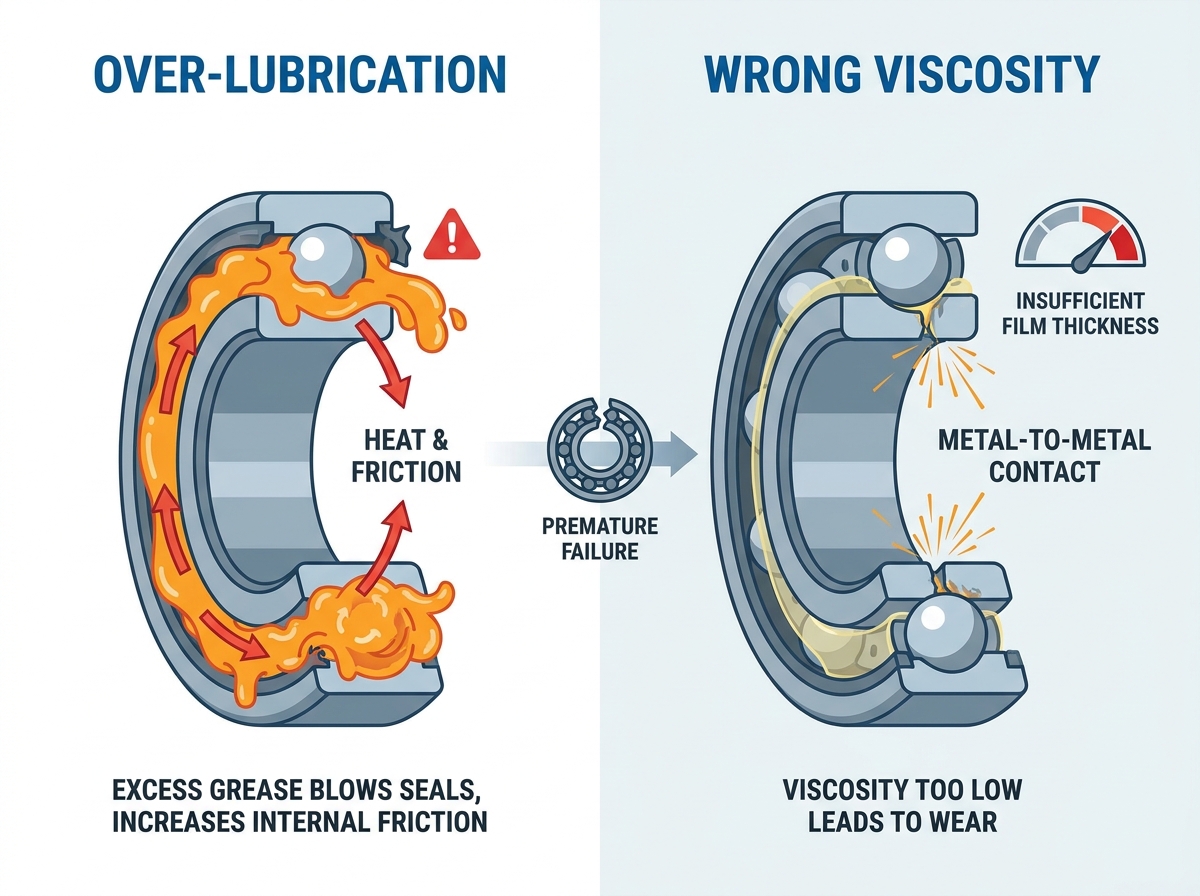
Even highly experienced technicians fall into common maintenance traps. Recognizing these errors prevents catastrophic machinery damage. Let us examine the four most destructive practices happening in facilities today.
Over-Lubrication (The Churning Effect): More grease does not equal better protection. Pumping excess grease into a closed housing causes intense fluid friction. The rolling elements must violently push through the heavy mass. This churning effect generates catastrophic internal heat. As temperatures skyrocket, the base oil oxidizes rapidly. Eventually, the immense pressure blows the outer seals outward. Broken seals invite immediate dirt and water ingress. Over-lubricated motors often fail faster than under-lubricated ones.
Mixing Incompatible Thickeners: Different grease thickeners often react terribly together. Mixing a lithium complex base alongside a polyurea base causes a severe chemical breakdown. The chemical structure collapses almost immediately. The mixture may harden like a solid rock inside the housing. Alternatively, it might soften drastically and leak out completely. This rapid oil bleed leaves the metal surfaces completely unprotected. You must completely purge old grease before switching brands.
Wrong Viscosity for Speed and Load: Base oil viscosity directly dictates the protective film thickness. You need elastohydrodynamic lubrication to separate metal surfaces. If the viscosity is too low, the oil film breaks under pressure. Metal-to-metal contact destroys the internal raceways rapidly. This leads to heavy spalling and pitting. If the viscosity is too high, the components suffer excessive fluid drag. This drag spikes energy consumption and elevates operating temperatures unnecessarily.
Contamination Blind Spots: Keeping grease perfectly clean requires constant daily vigilance. Many teams fail to protect components during routine washdowns. High-pressure water spray easily penetrates weak or damaged seals. Water severely degrades the lubricating film. Dust and abrasive particulate matter often enter during messy storage. Leaving grease buckets open invites airborne debris. Applying contaminated grease acts exactly like injecting liquid sandpaper directly into your machinery.
Choosing the correct fluid requires careful engineering analysis. You must evaluate base oils against your specific operating extremes. Mineral oils handle standard daily operations quite well. They offer excellent performance for moderate temperatures and normal speeds. However, synthetic oils become absolutely mandatory for extreme temperature fluctuations. Synthetic polyalphaolefins (PAO) resist thermal oxidation much longer than mineral variants. They also maintain excellent viscosity stability under severe mechanical shear.
Next, look closely at specific additive packages. Base oils need help to survive harsh industrial environments. Additives solve very specific operational problems.
Lubricant Additive Performance Mapping
Additive Type | Primary Function | Target Application Environment |
|---|---|---|
Extreme Pressure (EP) | Prevents metal scoring under heavy shock loads | Crushers, heavy presses, mining gear |
Anti-Wear (AW) | Reduces friction in moderate, steady loads | High-speed electric motors, fans |
Rust Inhibitors | Stops oxidation and surface corrosion chemically | Wet, humid, or washdown environments |
Solid Additives (MoS2) | Provides emergency dry lubrication film | Low-speed, heavy-duty sliding applications |
Tackifiers | Helps grease adhere to spinning surfaces | Open gears, vertical shaft alignments |
Regulatory compliance adds another critical layer of complexity. Food-grade processing requires NSF H1 certified formulas strictly. You must evaluate this compliance rigorously for consumer safety. However, you cannot simply sacrifice load capacity just to meet standards. Modern food-grade synthetics offer excellent protection without compromising safety.
Always demand concrete testing evidence from potential vendors. Never accept generalized marketing claims about superior wear protection. Ask for standardized ASTM test results instead. The ASTM 4-Ball Wear Test proves exactly how the fluid performs under immense pressure. Reviewing real test data separates premium products from inferior substitutes.
Manual greasing routes often suffer from intense human inconsistency. Technicians get busy and might miss a lubrication point entirely. They might also apply inconsistent amounts of grease using manual guns. One technician pumps three times, while another pumps ten. Automated systems completely eliminate these frustrating human variables. Single-point and multi-point automated lubricators deliver exact volumes precisely on schedule. They operate continuously while the machine runs.
However, adopting facility automation brings unique rollout challenges. You cannot simply install a new unit and walk away. You must carefully prepare the equipment first. Technicians must completely purge the old grease before system installation. Incompatible chemical mixtures will quickly ruin the new automated setup. Furthermore, you must properly calculate the precise dispense rate. Underfeeding causes rapid starvation and heat buildup. Overfeeding creates the dreaded churning effect discussed earlier.
Justifying the initial capital expenditure requires a structured ROI evaluation. Automated systems drastically reduce routine maintenance labor hours. Your team can focus on proactive reliability tasks instead. These systems lower overall grease consumption by eliminating wasteful over-greasing. They also enhance workplace safety significantly. Keeping personnel away from actively running machines prevents severe accidents. Finally, consistent micro-dosing extends the overall lifespan of every bearing in your facility. You achieve highly predictable, reliable, and profitable production runs.
Finding a dependable supplier involves looking well past the initial price tag. You want a true technical reliability partner. Your chosen vendor should offer comprehensive condition analysis programs. They must do much more than just sell consumable buckets. A strong partner helps you solve complex frictional challenges.
Evaluate potential vendor partners using these critical dimensions:
Comprehensive Testing Capabilities: They should provide routine oil and grease analysis services. This includes ferrography to detect microscopic metal wear.
Accessible Engineering Expertise: You need direct access to their specialized engineering support teams. Local representatives should understand your specific machinery intimately.
Technical Transparency: They must supply clear, updated Technical Data Sheets (TDS). These documents must list exact thickener types and base oil viscosities.
Supply Chain Stability: Their delivery timelines must be highly transparent and reliable. Stockouts of critical lubricants cause unacceptable production delays.
Training Resources: They should offer hands-on training for your maintenance staff. Proper application techniques require continuous education.
Take calculated steps before signing a massive bulk contract. We strongly recommend conducting a localized pilot test first. Choose a small group of highly problematic machines. Apply the new protocol and monitor the temperature results closely. Track the vibration signatures over several weeks. Alternatively, request a facility-wide lubrication audit. Let their engineers walk your floor. Allow them to identify your most critical fluid vulnerabilities directly.
Optimizing your lubrication strategy remains a very high-leverage decision. It directly impacts your overall facility profitability and safety. Ignoring proper fluid management invites sudden disaster and costly downtime. You have the power to change this reactive trajectory today. Start by auditing your most critical equipment assets immediately. Walk the production floor and actively look for blown seals. Check motor housings for obvious visual signs of over-lubrication. Inspect your storage room to ensure grease containers remain sealed properly. Finally, consult with a certified lubrication specialist. Let them align your product specifications with your harsh operational realities. Upgrading your approach guarantees smoother operations and longer equipment life.
A: You should use a standard industry formula to determine exact volume. Multiply the outside diameter (OD) by the width, and then multiply by a specific constant (typically 0.114 for ounces). This provides precise relubrication amounts. Never rely on the outdated method of pumping grease until it purges from the seals. That approach guarantees over-lubrication and destroys the internal components.
A: Mixing different thickeners causes severe chemical incompatibility. The resulting mixture undergoes extreme physical changes. It may soften dramatically and leak out of the housing. In other cases, it hardens into a solid mass. It also causes rapid oil separation. Once the base oil separates from the thickener, you lose all lubrication protection completely.
A: You cannot base relubrication solely on simple calendar dates. Intervals must be calculated using exact operating parameters. You must factor in rotational speed, bore size, and total operating hours. Environmental contamination plays a massive role as well. High heat or heavy dust environments require much shorter relubrication intervals to maintain safe operation.
A: Sealed components are typically sold as "lubricated for life." However, that life depends entirely on operating conditions. You generally cannot relubricate them because the seals prevent grease entry. Once the internal grease degrades or dries out, the unit must be replaced entirely. They offer convenience but limit your maintenance options in extreme applications.