Call Us Today
Call Us Today
A Specialist on Spherical Roller Bearings Since 1969

- All
- Product Name
- Product Keyword
- Product Model
- Product Summary
- Product Description
- Multi Field Search


Views: 0 Author: Site Editor Publish Time: 2026-07-14 Origin: Site


In industrial, automotive, and aerospace applications, every rotational system demands absolute precision to function effectively. Even minor deviations in a single component can severely impact overall mechanical performance. A non-compliant component can halt an entire production line in seconds, costing facilities heavily. Substandard parts introduce severe business risks ranging from unexpected downtime to catastrophic equipment failure. These inferior components also frequently void expensive machinery warranties when they inevitably fail under pressure. Verifying proper specifications remains absolutely essential to maintaining operational safety and maximizing daily productivity.
This article provides a definitive framework for evaluating manufacturing standards and verifying complex supplier claims safely. You will learn how to decode global tolerance ratings correctly for your specific operational environments. We will also guide you toward making fully compliant procurement decisions protecting your critical infrastructure.
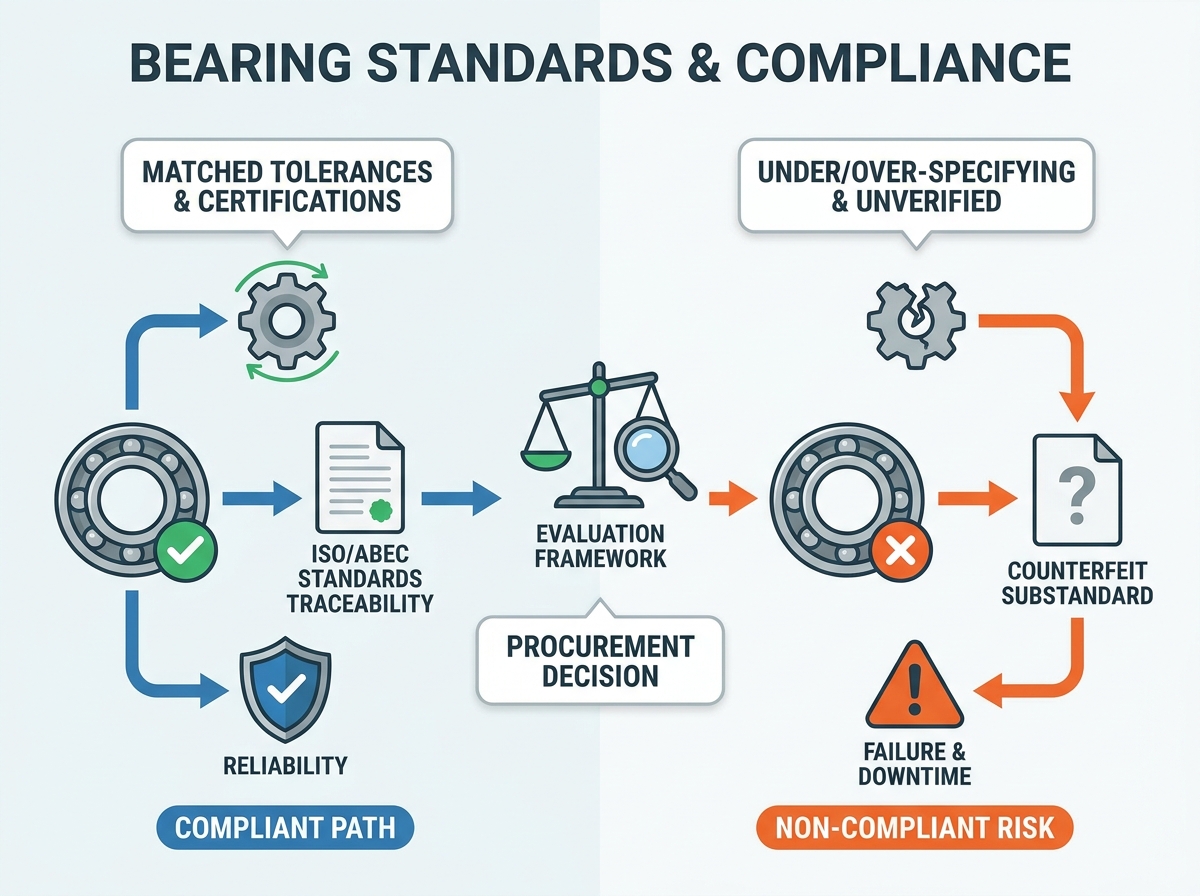
Matching standard tolerances (ISO, ABMA/ABEC) to your specific application prevents both premature failure and unnecessary over-spending.
Material traceability and industry-specific certifications (e.g., FDA, AS9100) are non-negotiable for highly regulated sectors.
Verifying an authorized supply chain is the most effective defense against the growing risk of counterfeit bearings.
Evaluating a supplier requires looking beyond part numbers to assess their quality management systems (QMS) and testing protocols.
We must first define clear success criteria for modern mechanical systems. Component quality directly dictates the Mean Time Between Failures (MTBF) for any complex machinery. High-quality parts keep systems running much longer between scheduled preventative maintenance intervals. Using sub-optimal parts drastically reduces MTBF and heavily disrupts operational stability. You need robust evaluation frameworks to measure this reliability accurately over time.
We see frequent mechanical problems when engineers under-specify components for demanding industrial applications. Choosing a bearing lacking adequate dynamic load ratings creates a highly dangerous cascade effect. Excessive vibration usually occurs first. This indicates early internal damage to the rolling elements. This initial vibration quickly leads to severe thermal runaway. Internal friction multiplies exponentially during this phase. Eventually, this extreme heat causes permanent shaft damage. At this point, the failure requires complete mechanical system replacement.
Conversely, over-specifying components creates an entirely different set of frustrating procurement problems. Many engineering teams fall into the costly trap of demanding ultra-high precision unnecessarily. They might repeatedly request ABEC 7 or ABEC 9 ratings for basic material conveyors. High-precision parts cost significantly more to manufacture, inspect, and procure globally. Using them in low-speed, low-precision applications wastes valuable procurement budget entirely. These highly expensive components yield absolutely no operational benefits in simple, slow-moving machinery. They offer zero performance advantages when installed in standard industrial gearboxes or agricultural equipment. You must match the component precision exactly to your specific application requirements. Doing so prevents unnecessary overspending while guaranteeing proper mechanical function.
To make informed procurement decisions, we must fully understand global standardization frameworks. The International Organization for Standardization (ISO) uses a strict metric tolerance progression system. These metric standards precisely dictate dimensional accuracy and maximum allowable rotational runout.
ISO Normal (Class 0): Suitable for standard electric motors, fans, and general machinery.
ISO Class 6: Required for medium-precision applications facing higher rotational speeds.
ISO Class 5: Necessary for high-speed machine tools and sensitive precision instruments.
ISO Class 4: Reserved strictly for ultra-high-precision aerospace and critical medical equipment.
Precision Level | ISO Metric Class | Primary Application | Cost Impact |
|---|---|---|---|
Standard | Normal (P0) | General manufacturing | Baseline |
Medium | Class 6 (P6) | High-speed motors | Moderate increase |
High | Class 5 (P5) | Machine tool spindles | High |
Ultra-High | Class 4 (P4) | Aerospace gyroscopes | Premium |
In North America, you will frequently encounter ABMA/ABEC ratings instead of ISO classes. ABEC ratings specifically measure imperial dimensional tolerances and dynamic rotational runout. However, we must clearly clarify what ABEC ratings actually fail to measure. An ABEC rating does not measure ultimate load capacity or internal material quality. It also tells you absolutely nothing about the lubricant type or outer seal effectiveness. Many inexperienced buyers mistakenly assume a high ABEC rating guarantees overall component durability. This dangerous assumption leads to frequent mechanical failures in heavy-duty applications.
Internal clearance standards, commonly known as C-Ratings, are equally critical for optimal performance. Radial internal clearance determines the physical microscopic space between the rolling elements. Standard clearance (CN) works perfectly for room-temperature operations lacking extreme interference fits. A C3 clearance provides vital extra room for thermal expansion during continuous high-speed operation. A C4 clearance serves extreme operating temperature environments strictly. Selecting the wrong internal clearance rating practically guarantees rapid and violent component failure. If you use standard clearance in high-heat environments, rapid thermal expansion causes immediate binding.
Different industrial sectors require highly specialized material certifications to ensure consumer and operational safety. In food and beverage processing facilities, rigorous compliance prevents catastrophic consumer health crises. Food processing equipment requires specialized solid lubricants officially approved by the FDA or NSF. These harsh environments also demand highly corrosion-resistant materials to survive aggressive daily chemical washdowns. Standard steel components rust incredibly fast when exposed repeatedly to acidic food products. Therefore, manufacturers rely heavily on premium AISI 440C stainless steel for these strict hygienic applications.
Aerospace and defense sectors operate under much stricter, unforgiving regulatory frameworks. Every single component must fully comply with the highly stringent AS9100 quality standard. Suppliers must provide comprehensive lot traceability from the initial raw ore to the finished product. Aerospace manufacturing also strictly requires NADCAP-approved special processes for complex heat treatment procedures. If a bearing lacks this detailed traceability, aerospace engineers simply cannot install it legally.
Heavy industrial and mining operations prioritize entirely different performance metrics for their equipment. These demanding sectors focus primarily on maximizing dynamic load ratings for massive crushing equipment. Mining environments present extreme daily contamination risks facing highly abrasive dust and thick slurry. Evaluating seal efficacy becomes the single most important factor in extending component longevity. Even the strongest hardened steel will fail rapidly if abrasive dirt breaches the protective seal.
To guarantee full industrial compliance, you must demand proper official documentation from your suppliers.
Request Mill Test Reports (MTR) to verify precise raw material chemical compositions.
Demand a signed Certificate of Conformance (CoC) for every single shipped batch.
Keep all physical documentation carefully archived to satisfy future regulatory audits easily.
Cross-reference printed lot numbers against the provided certificates immediately upon arrival.
The global supply chain currently faces a massive and rapidly growing counterfeit threat. Illicit manufacturers flood the international market heavily producing fake premium-brand components every single day. These counterfeit parts look completely visually identical to authentic, highly engineered products. They often display expertly copied branding, similar packaging, and forged certification documents. Installing a counterfeit part introduces extreme physical risk to heavy machinery operators. These fakes utilize heavily inferior steel prone to cracking under moderate operational stress.
We must implement rigorous authentication methods to evaluate true supply chain transparency. The most effective defense involves purchasing strictly from formally authorized, vetted regional distributors. Authorized distributors maintain direct, legally binding commercial relationships establishing product origin confidently. Never source critical rotational components from unverified online marketplaces or anonymous gray-market brokers. True transparency requires vendors to prove their exact sourcing channels without any hesitation.
Physical verification provides an essential secondary defense layer during your incoming inspection process. Your quality control team must learn how to quickly identify common counterfeit red flags.
Inspect the intricate laser etching on the outer ring very carefully. Counterfeits often feature fuzzy, misaligned, or improperly sized font types.
Examine the overall packaging quality of the individual cardboard boxes. Authentic manufacturers use high-quality cardboard, precise vibrant printing, and highly secure holograms.
Check for the physical presence of factory-applied protective preservation oils. Fake parts frequently arrive completely dry or coated improperly in cheap grease.
Evaluating a new potential supplier requires looking far beyond standard catalog part numbers. You must thoroughly assess their complex internal quality management systems (QMS) first. Verify the supplier holds an active, properly audited ISO 9001:2015 certification. Treat this basic certification purely as a foundational baseline, not a final guarantee. Look much deeper for specialized in-house metrology and highly advanced endurance testing capabilities. The absolute best suppliers test their own products rigorously before shipping them globally.
Prototyping and initial validation serve as absolutely crucial steps for custom component procurement. You should carefully set strict expectations for comprehensive First Article Inspection (FAI) reports. An FAI report systematically verifies every single dimensional tolerance on the initial production batch. We highly recommend evaluating an initial sample run practically before approving mass production. This critical validation phase prevents highly costly reworks and massive production delays later.
Conducting a physical or detailed virtual vendor audit reveals their true manufacturing capabilities. Use this highly targeted checklist when auditing any prospective component manufacturer:
Verify the true origin and certification covering all raw material sourcing channels.
Inspect their automated heat treatment controls and digital temperature logging systems.
Evaluate their automated grinding and precision honing equipment for modern accuracy.
Review their strict internal non-conformance quarantine and scrap procedures.
Assess the absolute cleanliness characterizing their final assembly and packaging cleanrooms.
After completing your vendor audits, you must outline the exact next steps carefully. Initiate a formal technical consultation alongside your newly chosen supplier's engineering team. You must perfectly match exact operating parameters against the right certified component. Share your specific rotational speed, radial load, and ambient temperature requirements openly. An experienced engineering supplier will use this accurate data to recommend the optimal solution.
Verifying component standards remains a highly continuous, active operational risk-management process. It is never simply a one-time purchasing check or a brief mandatory paperwork exercise. Consistent ongoing verification ensures your machinery operates safely over its entire intended mechanical lifespan. We strongly advise readers to prioritize highly transparent, fully certified suppliers for all critical parts. Choose dedicated partners who readily provide expert engineering support and fully traceable documentation. Protect your production schedules consistently by eliminating unverified gray-market sourcing entirely.
Take immediate proactive action to secure your vulnerable supply chain today. Contact an experienced engineering team to review your current component specifications thoroughly. Request a comprehensive compliance audit of your existing spare parts inventory immediately. Ensuring your rotational components meet stringent global standards guarantees much better operational reliability across all facilities.
A: No, it does not. An ABEC rating only dictates dimensional precision and rotational runout limits. It does not measure material strength, internal geometry, or overall load capacity. A high-precision ABEC 7 component can easily fail under heavy loads if the underlying design does not match your specific weight requirements.
A: ISO Class 5 roughly translates to ABEC 5 in the imperial rating system. Knowing this exact cross-reference helps significantly during global procurement translation. It ensures you order the correct precision level regardless of whether the manufacturer uses metric ISO standards or imperial ABEC classifications.
A: You must always request a Certificate of Conformance (CoC) directly from your supplier.
A: Premature failure usually stems from operational mismatches rather than dimensional inaccuracies. You might have overlooked crucial factors like incorrect internal clearance (using standard instead of C3). Improper lubrication types, excessive operating temperatures, or fundamental mounting errors easily destroy perfectly machined components long before their rated lifespan ends.