Call Us Today
Call Us Today
A Specialist on Spherical Roller Bearings Since 1969

- All
- Product Name
- Product Keyword
- Product Model
- Product Summary
- Product Description
- Multi Field Search


Views: 0 Author: Site Editor Publish Time: 2026-07-24 Origin: Site


Specifying the right bearing goes far beyond basic dimensions and dynamic load ratings. The metallurgical composition and thermal processing determine if the component will survive its operating environment. Relying solely on catalog numbers ignores invisible material factors. Choosing the wrong metallurgy guarantees early breakdown in demanding industrial conditions.
Premature bearing failure is rarely a mechanical sizing error. It is typically driven by material mismatch regarding corrosion, temperature limits, or lubrication starvation. Standard steels break down quickly when exposed to harsh chemicals. Excessive heat permanently alters internal crystalline structures. These environmental realities demand a deeper engineering review.
This guide breaks down the technical realities of bearing steels, cage materials, and heat treatments. It helps engineering and procurement teams finalize material specifications based on verifiable performance thresholds. You will learn to move past assumed defaults and build robust application parameters. Selecting the right combination ensures continuous operation and maximum reliability.
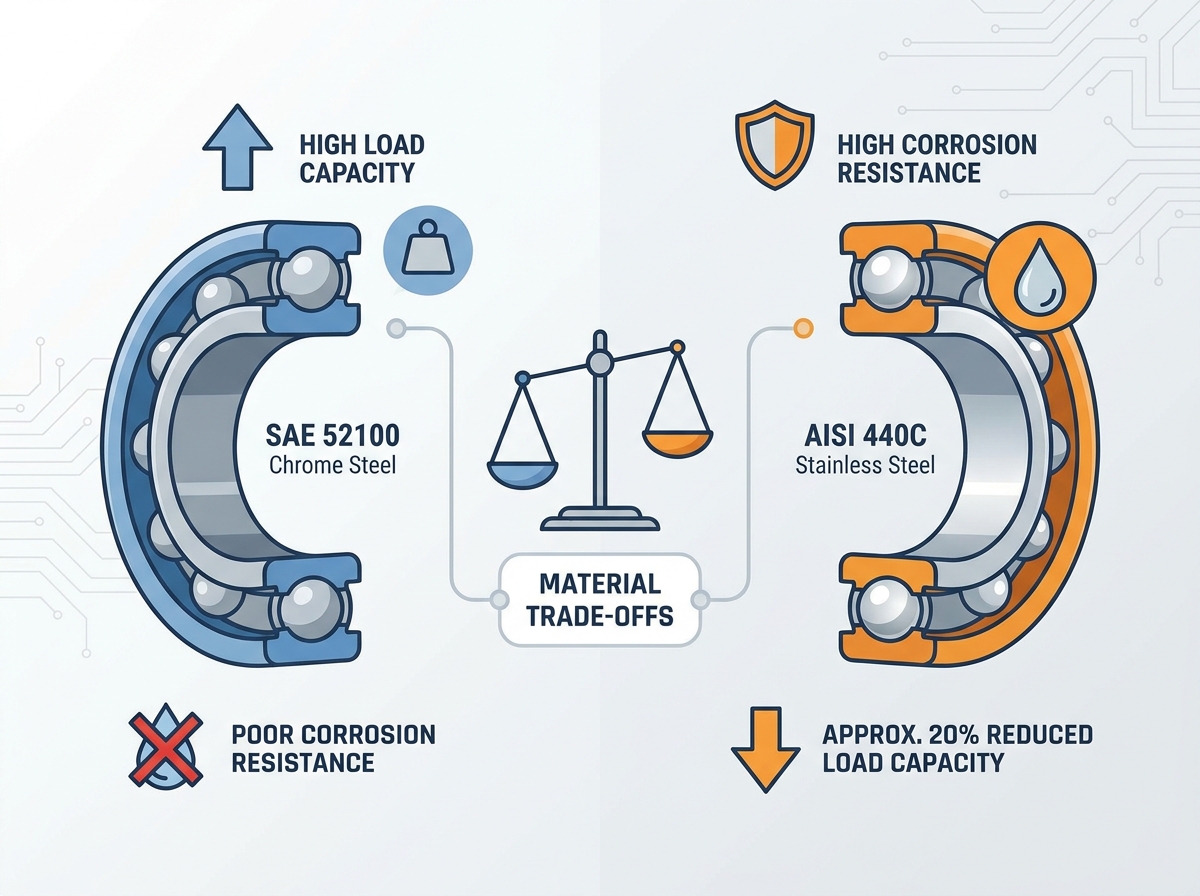
GCr15/SAE 52100 Chrome Steel remains the industry baseline for high-load applications, but it requires strict environmental controls to prevent oxidation.
440C Stainless Steel provides essential corrosion resistance but forces a compromise, typically reducing dynamic load capacity by approximately 20% compared to chrome steel.
Heat treatment protocols (such as dimensional stabilization) are critical variables; standard bearings may suffer metallurgical phase changes and seize if operated above 120°C (250°F) without proper tempering.
Cage material often dictates the maximum operating speed and temperature limit of the entire bearing assembly, making polymer vs. metal selection a primary failure-point consideration.
Material failure carries massive downstream business impacts. Unplanned downtime stops production lines immediately. Contaminated product lines cause catastrophic recalls in food and medical manufacturing. Sudden component seizures cause catastrophic equipment damage. The initial purchase price of a well-specified bearing pales compared to these operational losses.
Engineering reality dictates a harsh truth. No single material excels in load, speed, corrosion resistance, and temperature simultaneously. Upgrading corrosion resistance usually degrades load capacity. Increasing temperature limits often decreases overall material hardness. We must balance these competing material properties against real-world application demands.
You must frame the selection process around three non-negotiable limits. If a component exceeds any of these thresholds, failure becomes imminent.
Maximum Operating Temperature: Peak thermal conditions dictate both steel stabilization requirements and cage material survival. Thermal expansion eliminates internal clearance quickly.
Corrosive Exposure: Moisture, caustic chemicals, and vacuum environments destroy standard carbon steels. You must evaluate washdown procedures and atmospheric humidity accurately.
Shock Load Requirements: Extreme impacts fracture brittle materials. Heavy industrial applications demand ductile cores rather than uniform extreme hardness.
Engineers evaluate rolling contact materials based on fatigue life and environmental resistance. The rings and rolling elements bear the brunt of dynamic stresses. Choosing the proper base alloy dictates the ultimate physical limits of the assembly.
GCr15/SAE 52100 chrome steel serves as the universal baseline. It is a high-carbon, high-chromium alloy offering exceptional hardness. Heat treatment typically achieves 58-65 HRC. This hardness provides excellent fatigue life under heavy dynamic loads. The steel structure resists rolling contact fatigue incredibly well.
However, 52100 steel carries strict limitations. It is highly susceptible to corrosion. Moisture rapidly oxidizes the surface. You must restrict this material to well-lubricated, protected environments. Oil or grease films must constantly protect the bare steel from ambient humidity.
AISI 440C stainless steel provides a reliable alternative for harsh environments. It is a high-carbon martensitic stainless steel. The high chromium content resists oxidation and mild chemicals effectively. Food processing and medical devices rely heavily on 440C.
The primary limitation is a lower fatigue life than 52100. Specifying 440C requires recalculating the L10 life. Dynamic load ratings typically drop by 20 percent. You cannot simply swap 52100 for 440C without verifying the new load limits against application stresses.
Hybrid assemblies utilize Silicon Nitride (Si3N4) rolling elements. These ceramic elements serve niche applications. They provide crucial electrical insulation. This prevents electrical pitting in variable frequency drive motors. Ceramic balls also excel at extreme RPMs. Steel centrifugal mass becomes a liability at ultra-high speeds, whereas lighter ceramic prevents skidding.
Rolling Contact Material Comparison
Material Type | Standard Hardness | Corrosion Resistance | Load Capacity |
|---|---|---|---|
GCr15/SAE 52100 Chrome Steel | 58-65 HRC | Poor | 100% (Baseline) |
AISI 440C Stainless | 58-62 HRC | Good | ~80% of Baseline |
Silicon Nitride (Ceramic) | 70+ HRC | Excellent | Varies by ring material |
Raw steel requires precise thermal manipulation before it becomes a viable component. Heat treatment alters the microstructural properties of the alloy. This processing step determines wear resistance, toughness, and thermal stability. Overlooking heat treatment guarantees application failure.
Through-hardening provides uniform wear resistance throughout the entire cross-section. It is the standard process for GCr15/52100 steel. The material achieves maximum hardness from the surface to the core. This suits applications requiring maximum fatigue life under steady loads.
Case carburizing produces a different microstructural profile. It creates a hard outer shell over a softer, ductile core. Heavy industry applications rely on this method. Extreme shock loads would fracture brittle through-hardened steel. The ductile core absorbs impacts while the hard case resists surface wear.
Quenching methods dictate specific structural trade-offs. Standard martensitic quenching maximizes peak hardness. However, it can leave the steel brittle. Bainitic hardening yields slightly lower hardness. It compensates by providing greater toughness and crack resistance. Engineers specify bainitic quenching for inner rings mounted with heavy interference fits.
Standard heat treatments leave small amounts of retained austenite in the steel. High temperatures force this austenite to transform into martensite. This metallurgical phase change causes the steel to permanently expand. The component will lose internal clearance and seize on the shaft.
Manufacturers apply dimensional stabilization to prevent this catastrophic expansion. They temper the steel at elevated temperatures to eliminate retained austenite prematurely. Higher temperature stabilization inherently reduces overall material hardness. You must account for slightly reduced load capacities when specifying these grades.
S0 Grade: Stabilized for operations up to 150°C (302°F).
S1 Grade: Stabilized for operations up to 200°C (392°F).
S2 Grade: Stabilized for operations up to 250°C (482°F).
S3 Grade: Stabilized for operations up to 300°C (572°F).
The cage maintains precise spacing between rolling elements. It prevents ball-to-ball contact and manages lubricant distribution. Cage material often dictates the ultimate speed and temperature ceiling of the entire assembly. Selecting the wrong retainer material causes rapid frictional failure.
Stamped steel cages provide a highly cost-effective baseline. They handle high temperatures easily. They offer excellent chemical compatibility. However, steel on steel generates significant friction. Stamped cages are prone to rapid wear if lubrication starves. They require consistent oil or grease films.
Machined brass cages offer superior performance under heavy vibration. Brass provides natural lubricity. It survives marginal lubrication scenarios much better than steel. Large industrial applications prefer machined brass. It withstands massive acceleration forces. The primary drawbacks remain increased weight and higher manufacturing costs.
Polymer cages dominate high-speed applications. They generate very low friction. They operate momentarily without lubrication without causing catastrophic damage. Polymers also accommodate slight shaft misalignment well. Their light weight reduces centrifugal forces dramatically.
Implementation risks revolve around strict temperature ceilings. Polyamide 66 (PA66) degrades rapidly above 120°C. Standard polymers also suffer chemical vulnerabilities. Specific synthetic lubricants contain aggressive extreme pressure (EP) additives. These chemicals can embrittle the plastic over time. You must verify lubricant compatibility before specifying standard polymer cages.
Advanced polymers like PEEK solve many of these issues. PEEK withstands temperatures exceeding 200°C. It resists aggressive washdown chemicals and harsh synthetic lubricants. However, PEEK commands a premium price and often requires custom manufacturing runs.
Cage Material Chart
Cage Material | Friction Level | Max Temp Ceiling | Best Application Fit |
|---|---|---|---|
Stamped Steel | Moderate | > 300°C | General purpose, high temp |
Machined Brass | Moderate/Low | > 250°C | High vibration, marginal lube |
Polyamide 66 | Very Low | 120°C | High speed, low noise |
PEEK | Very Low | > 200°C | Chemical exposure, high speed |
Aligning materials to specific applications requires a systematic approach. You must cross-reference environmental realities against metallurgical limits. Procurement teams must also understand how material choices impact supply chain availability. Custom configurations dramatically alter lead times.
Different industries demand highly specialized material profiles. Avoid universal defaults. Map your specific constraints to proven material combinations.
Food & Beverage / Medical: Specify 440C stainless rings. Pair them with PEEK or stainless cages. Mandate food-grade lubricants. This prevents rust during chemical washdowns.
High-Temperature Kilns/Furnaces: Specify S3 stabilized GCr15/52100 steel. Mandate machined steel cages. Avoid all polymer components. Ensure high-temperature dry lubricants are applied.
High-Vibration / Mining: Specify case-carburized steel. Pair it with machined brass cages. This combination absorbs brutal shock loads without fracturing.
Supply chain realities dictate engineering choices. GCr15/SAE 52100 steel with stamped steel cages and brass cages are universally stocked. You can source these COTS components immediately. They offer low costs and instant availability.
Advanced material specifications change this dynamic. Specifying PEEK cages moves the order into custom manufacturing. Requesting bainitic hardening limits available vendors. Demanding S2 or S3 dimensional stabilization guarantees extended lead times. You must balance the engineering requirement against procurement timelines.
Engineering teams must transition from assumption to verification. Verify actual operating temperatures rather than relying on ambient room data. Calculate the adjusted L10 life if you switch to stainless options. Always request material test reports (MTRs) from your vendor. Consult your manufacturer or bearing supplier before finalizing high-risk applications. Transparency prevents catastrophic field failures.
Successful component integration requires aligning multiple variables. You must balance steel composition, heat treatment, and cage material against environmental constraints. Ignoring any single factor jeopardizes the entire mechanical system. Standard defaults fail rapidly in extreme heat or corrosive environments.
Technical buyers must present exact operating environments to their manufacturers. Detail your temperature peaks, chemical washdowns, and shock load expectations. Do not just request a dimensional match. Verifying material capabilities ensures long-term operational reliability. Proper specification eliminates unplanned downtime and protects critical machinery.
A: Standard 52100 steel contains retained austenite. When heated above 120°C, this structure transforms into martensite. This phase change causes the steel to permanently expand. The component loses internal clearance and seizes on the shaft. High temperatures require S-class dimensional stabilization.
A: No. 440C stainless steel has lower fatigue life than 52100 chrome steel. Specifying stainless typically reduces the dynamic load capacity by approximately 20 percent. You must always recalculate your expected L10 life when switching to stainless options.
A: You should specify machined brass for high-vibration and high-acceleration environments. Brass provides natural lubricity. It survives marginal lubrication scenarios much better than steel. It is the standard choice for heavy industrial equipment and mining applications.
A: It depends on the polymer. Standard Polyamide 66 (PA66) degrades quickly under high heat or aggressive extreme pressure (EP) lubricant additives. However, high-end PEEK polymers withstand harsh washdown chemicals and temperatures exceeding 200°C seamlessly.