Call Us Today
Call Us Today
A Specialist on Spherical Roller Bearings Since 1969

- All
- Product Name
- Product Keyword
- Product Model
- Product Summary
- Product Description
- Multi Field Search


Views: 0 Author: Site Editor Publish Time: 2026-07-21 Origin: Site


Unplanned downtime mercilessly crushes profit margins in continuous textile production operations. When spinning frames or weaving looms halt unexpectedly, plant managers face ruined material batches and expensive emergency repairs. Every second of lost production erodes your competitive edge. Textile machinery relies entirely on its mechanical foundation to function. A precisely engineered bearing dictates spindle speed, fabric tension accuracy, and overall equipment effectiveness. Without reliable rotating components, maintaining exact mechanical synchronization becomes impossible.
Upgrading your rotating components shifts maintenance from reactive firefighting to predictable performance. It directly impacts product precision and plant profitability. Proper specification prevents premature failures in harsh, lint-filled environments. In this guide, we will explore how suboptimal selections throttle your business throughput. We will detail specific component solutions for spinning, weaving, and dyeing applications. Finally, you will learn actionable strategies for proper installation and lifecycle management to maximize plant uptime.
Selecting the right bearing requires balancing high-speed capabilities with robust sealing technologies to combat heavy lint and dust environments.
Precision in spinning and weaving is intrinsically linked to bearing runout and vibration tolerances.
Implementation success depends equally on component selection, precise installation protocols, and lifecycle lubrication management.
Microscopic wear inside a machine often translates to macroscopic production flaws. When a rolling element degrades, it introduces slight rotational inconsistencies. This microscopic vibration quickly affects the entire spindle assembly. Uneven yarn tension quickly follows this initial degradation. You will soon notice visible fabric defects. Frequent yarn breakage becomes a daily operational headache. These quality issues ruin large batches of expensive raw material. They also damage your reputation among strict commercial buyers. Operators often struggle to diagnose the root cause immediately. They might tweak tensioner settings unnecessarily. Meanwhile, the mechanical foundation continues to deteriorate silently.
Catastrophic failures compound these daily losses significantly. Imagine a critical rotational failure occurring mid-run. The loom or spinning frame stops immediately. Idle labor costs accumulate rapidly while technicians scramble for tools. You lose the sensitive material currently threaded on the machine. Furthermore, you must often pay premium freight rates. Rush-shipping replacement parts eats directly into your profit margins. A seemingly cheap component suddenly costs thousands of dollars in lost throughput. The entire production schedule shifts backward. Subsequent processing stages starve for material. This domino effect jeopardizes your delivery commitments to clients.
Standard or mismatched parts create hidden performance bottlenecks. Machine builders design modern textile equipment for incredible operational speeds. However, lower-tier components cannot handle these extreme thermal loads. They fail rapidly under intense dynamic stresses. Maintenance teams respond by reducing operating speeds artificially. This conservative approach prevents premature mechanical failure. Unfortunately, it also caps overall plant throughput. You artificially limit your revenue potential just to keep the machines running reliably. Upgrading these constraints unlocks the true design capacity of your equipment. It allows you to run faster without sacrificing safety or product quality.
Spinning frames operate at extreme rotational velocities continuously. They require exceptionally low friction to prevent rapid overheating. Heat dissipation is critical for non-stop operation. You need high-speed stability to maintain consistent yarn twist. Without stability, the yarn strength varies wildly. Engineers typically specify precision angular contact ball bearings for these nodes. Specialized spindle bearings also excel in this application. They handle both radial and axial loads efficiently at high RPMs. Their internal geometry minimizes friction generation significantly. This keeps operating temperatures safely within acceptable limits.
Weaving introduces completely different mechanical stresses to the system. The equipment handles intense, continuous start-stop cycles. The beat-up mechanism generates massive, repetitive impact forces. You need components offering incredibly high shock-load resistance. Durability under oscillating conditions is absolutely non-negotiable here. Cylindrical roller bearings handle these severe radial impacts beautifully. They distribute the shock across a wider contact area. Needle roller bearings also provide excellent load capacity. They fit perfectly into the tight spatial constraints often found in knitting cams.
Finishing environments are notoriously harsh on mechanical components. The machinery operates constantly in high ambient temperatures. It faces extreme moisture and highly corrosive chemical exposure. Standard steel parts will rust and fail rapidly here. You must deploy specialized material solutions for longevity. Stainless steel units offer strong baseline corrosion resistance. Ceramic hybrid components perform exceptionally well in wet zones. They resist chemical degradation and require minimal lubrication. You might also consider specialized polymer solid-lube options. These innovative solutions eliminate chemical washout risks entirely.
Application Comparison Guide
Textile Process | Primary Mechanical Challenge | Optimal Solution |
|---|---|---|
High-Speed Spinning | Extreme RPMs, Heat Generation | Precision angular contact ball bearings |
Weaving & Knitting | Shock loads, Start-stop cycles | Cylindrical / Needle roller bearings |
Dyeing & Finishing | Moisture, Heat, Chemicals | Ceramic hybrids, Stainless steel |
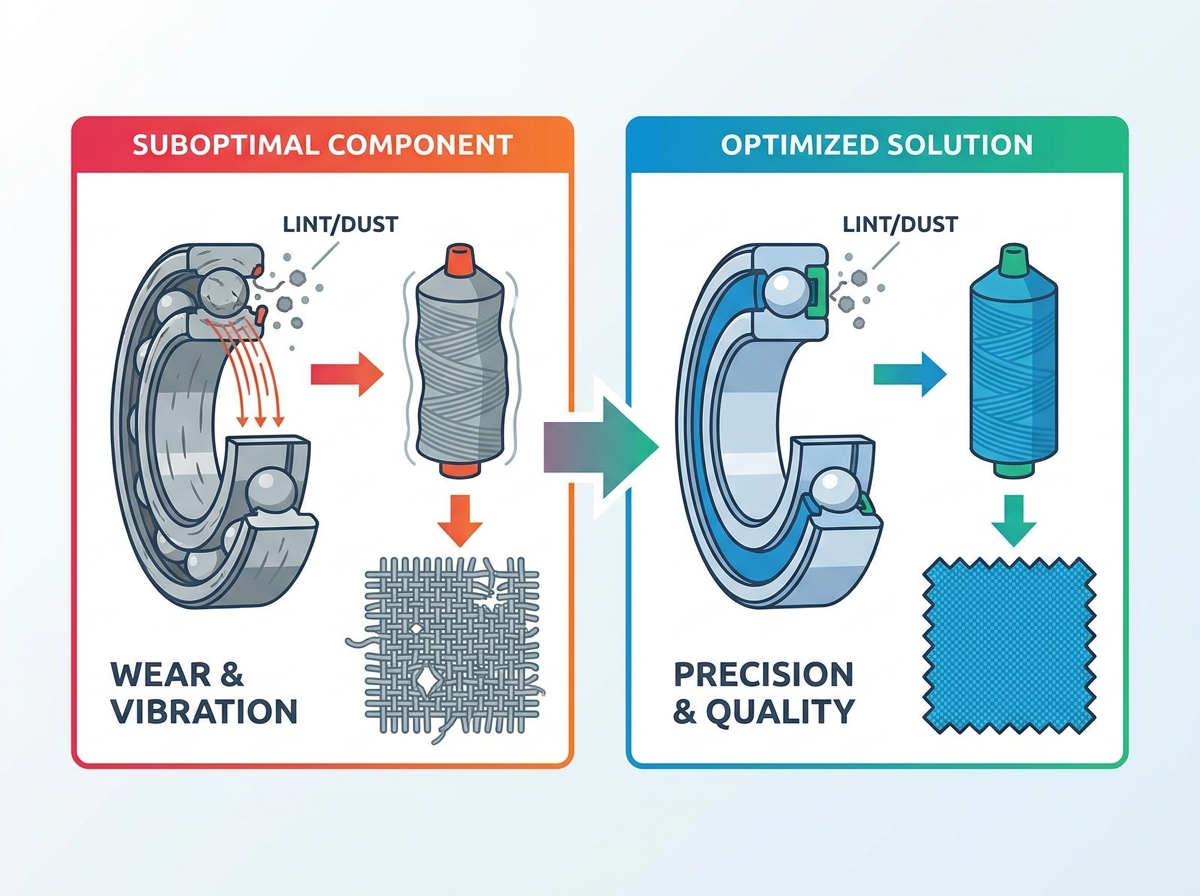
Textile plants generate extreme levels of airborne particulates daily. Lint and dust float constantly in the production air. These abrasive contaminants destroy raceways if they penetrate the housing. You must carefully evaluate contact versus non-contact seals. Contact seals provide excellent physical ingress protection. However, they add unwanted friction at very high speeds. Non-contact shields reduce friction but offer less protection against fine dust. We highly recommend prioritizing labyrinth sealing systems. They force contaminants through a complex path. They block lint effectively without adding unacceptable rotational friction.
Lubrication requires a delicate and precise balancing act. Over-lubrication attracts dust and creates a highly abrasive paste. Under-lubrication guarantees rapid metal-to-metal wear. You need to thoroughly assess "sealed-for-life" options. These eliminate manual greasing errors entirely. They also prevent contamination during routine maintenance procedures. Alternatively, heavily loaded systems might require automated lubrication routing. Always match the grease formulation to the specific application. Consider specialized high-temperature greases for dyeing and finishing zones. You can consult a reliable bearing specialist to determine the exact fill volume required for optimal performance.
Machine vibration relentlessly destroys output quality. You must control internal clearances carefully during specification. During operation, friction heat causes metal components to expand. If the initial clearance is too tight, the unit seizes. If it is too loose, the spindle vibrates uncontrollably. Match the internal clearance rating to the expected operating temperature. Industry standards like C3 or C4 denote specific expansion allowances. Specify tighter tolerance classes for high-speed spindles. This minimizes mechanical runout and ensures perfectly smooth, concentric rotation.
Improper mounting accounts for a massive percentage of early component failures. Mechanics sometimes use hammers to force parts onto shafts. These crude impact forces permanently dent the delicate raceways. Misalignment during installation also creates severely uneven load distribution. You should strictly forbid brute-force installation methods on the factory floor. Follow these best practices for proper mounting:
Clean the shaft and housing thoroughly to remove microscopic debris.
Heat the inner ring precisely using a professional induction heater.
Slide the component smoothly onto the shaft without any mechanical impact.
Allow the metal to cool and contract naturally for a secure interference fit.
Specialized pressing tools also ensure perfectly even force distribution when cold mounting is necessary.
A pristine environment is absolutely crucial during installation. We must emphasize surgical cleanliness for longevity. Never unwrap a new component until you are completely ready to mount it. Keep the shaft and housing perfectly clean at all times. A single strand of cotton lint causes significant damage. A microscopic speck of dust acts like sandpaper. Trapped debris creates immediate stress risers inside the raceway. Wipe down all adjacent machine surfaces before beginning the mounting process. Use lint-free cloths exclusively during maintenance tasks.
You should actively shift away from basic scheduled maintenance. Calendar-based replacements often swap out perfectly healthy parts prematurely. Instead, adopt intelligent predictive maintenance strategies. Use vibration analysis tools to monitor rotating health continuously. Thermal imaging cameras easily detect abnormal friction heat signatures. These advanced technologies spot metal fatigue long before catastrophic failure occurs. They allow you to schedule downtime precisely on your own terms. Predictive monitoring drastically reduces unnecessary labor and maximizes component utilization.
Savvy plant managers look far past the initial purchase price. A cheap part always costs much more in the long run. You must calculate the long-term operational value comprehensively. Factor in the Mean Time Between Failures (MTBF) realistically. Consider the costly maintenance labor required for frequent replacements. Do not forget hidden energy consumption penalties. High-friction components force drive motors to work significantly harder. Efficient rolling elements reduce energy costs tangibly across hundreds of active spindles. Quality engineering always pays for itself through extended uptime.
Suppliers often make incredibly bold durability claims. You must verify these marketing statements rigorously. Ask your purchasing team to request specific lifecycle testing data. Generalized industrial benchmarks mean very little in a textile plant. You need data modeled specifically for high-lint, high-speed environments. Ask the manufacturer how their seals perform against penetrating cotton dust. Demand relevant case studies showing successful implementations. Look for operations running similar weaving or spinning equipment under identical stresses.
A reliable supply chain is your best defense against prolonged downtime. Evaluate potential vendors based on these critical support factors:
Availability of robust local inventory for rapid emergency replacement.
Strict counterfeit prevention measures and complete product traceability.
Access to on-site technical engineering support for troubleshooting.
You cannot afford to wait weeks for overseas shipping during a breakdown. Always buy through authorized distributors to guarantee absolute authenticity. A strong vendor partner helps you solve complex vibration issues directly on your factory floor.
Optimized component selection represents a highly strategic investment in plant reliability. It is far more than just a routine maintenance line item. When you prioritize proper sealing, lubrication, and precision, your machinery runs flawlessly. You eliminate the root causes of frustrating fabric defects and unexpected shutdowns. Your maintenance team confidently shifts from putting out fires to optimizing performance. Machinery reaches its true designed speed potential.
We encourage you to conduct a comprehensive mechanical audit of your facility. Identify the specific machinery nodes experiencing the highest historical failure rates. Document the unique environmental challenges present in those specific zones. Once you gather this critical data, consult with a qualified application engineer. They will help you thoroughly evaluate practical, cost-effective upgrade paths. Taking decisive action today secures your competitive production capacity for tomorrow.
A: Contamination and improper lubrication are the primary culprits. Airborne lint and dust easily bypass weak seals. Once inside, this debris mixes with grease to form a highly abrasive paste. This paste aggressively degrades the raceway and rolling elements. Under-lubrication also causes excessive friction, leading to rapid thermal breakdown and catastrophic seizure.
A: Replacement should be strictly condition-based rather than tied to a rigid calendar schedule. Use vibration analysis and thermal data to accurately monitor component health. Alternatively, follow specific OEM operating hour guidelines. Environmental factors like airborne dust heavily skew actual lifespan, making predictive monitoring the absolute safest approach.
A: They offer immense value in specific extreme environments. Ceramic hybrids excel in high-speed, high-temperature, or low-lubrication zones like dyeing equipment. They resist corrosion entirely and operate significantly cooler. However, they are usually unnecessary for standard load-bearing loom applications, where traditional steel components provide excellent durability at a lower cost.
A: Excessive internal clearance or poor tolerance causes mechanical runout. This runout creates continuous spindle vibration. The vibration immediately translates into highly inconsistent yarn tension. Fluctuating tension directly causes sudden yarn breakages and uneven fabric density, ultimately ruining the final product quality and increasing material waste.