Call Us Today
Call Us Today
A Specialist on Spherical Roller Bearings Since 1969

- All
- Product Name
- Product Keyword
- Product Model
- Product Summary
- Product Description
- Multi Field Search


Views: 0 Author: Site Editor Publish Time: 2026-07-28 Origin: Site


Premature bearing failure in harsh environments drives unacceptable downtime and maintenance costs. Facilities lose significant revenue when critical machinery suddenly stops operating. Equipment managers face constant pressure to keep assembly lines moving efficiently.
Standard steel components like 52100 alloy excel under normal conditions. However, they degrade rapidly when exposed to moisture, chemicals, or abrasive particulates. Heavy loads accelerate this wear pattern significantly. Extreme operating environments simply destroy unprotected metal surfaces.
Surface coatings bridge the gap between standard steel components and high-cost exotic materials like full ceramics. They offer a highly engineered, cost-effective solution for extending equipment lifecycle. This guide breaks down how to evaluate and specify the right coating for your exact wear and corrosion challenges. You will learn to protect your equipment and maximize operational uptime.
Coated bearings alter surface metallurgy to significantly reduce the coefficient of friction and block oxidation, extending maintenance intervals in severe environments.
Selecting the correct coating requires balancing three variables: load capacity, operating temperature, and the specific corrosive or abrasive agent present.
Proper specification must account for coating thickness, as adding material alters internal bearing clearances and requires strict dimensional tolerance management.
Evaluating lifecycle ROI—rather than initial unit cost—is critical when comparing coated variants against standard bearing options.
Standard steel components face extreme challenges daily. Boundary lubrication failure occurs when oil films break down under pressure. Metal-to-metal contact then initiates destructive micro-welding along the raceways. Galvanic corrosion destroys standard components rapidly in wet environments. You must replace these degraded parts constantly to prevent catastrophic machine failure.
Engineers must frame the financial justification clearly. A coated component carries a noticeable upfront premium. However, you must compare this against the compounded costs of machine downtime. Labor expenses for frequent replacements add up quickly over time. Evaluating lifecycle ROI reveals the true financial benefit. A highly engineered surface layer drastically improves long-term equipment profitability.
Procurement teams often consider upgrading entirely to stainless steel. Yet, this approach is not always viable. Stainless steel typically exhibits much lower load capacities. It also suffers from lower fatigue limits compared to 52100 steel. Coatings offer a superior structural compromise. They maintain the structural integrity of high-carbon steel while adding necessary surface protection.
Common Mistakes:
Upgrading to stainless steel without recalculating dynamic load ratings.
Ignoring labor costs when comparing standard and coated component prices.
Assuming factory-applied rust inhibitors provide long-term operational protection.
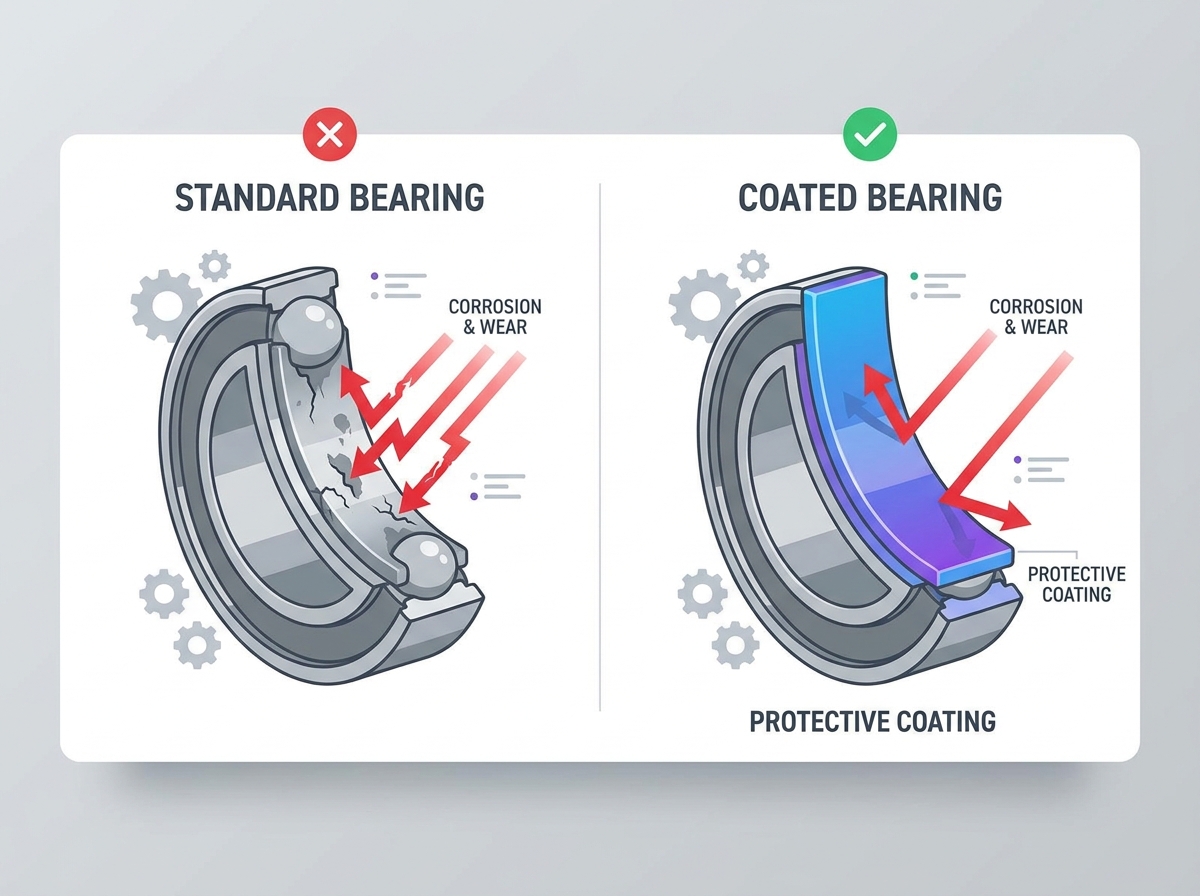
You need to understand how these applied layers function at a microscopic level. Different treatments solve distinct mechanical and chemical problems.
Tribological Improvements (Wear Resistance): Coatings increase surface hardness significantly. They resist abrasive wear from cement dust or mining particulates. They also reduce adhesive wear during marginal lubrication states. Harder surfaces prevent foreign debris from deeply indenting the raceway.
Chemical and Moisture Barriers (Corrosion Resistance): Non-porous layers act as physical shields. They prevent oxidation and resist caustic chemical washdowns effectively. These barriers also prevent hydrogen embrittlement. Hydrogen embrittlement often causes sudden, catastrophic fracturing in standard bearing steels.
Friction Reduction and Heat Dissipation: Specific treatments actively lower the friction coefficient. Lower friction directly reduces operating temperatures inside the housing. Cooler operation extends the life of the lubricant. It prevents premature grease dry-out and thermal degradation.
Tribological frameworks dictate that surface energy dictates wear rates. Applied layers alter this surface energy fundamentally. They create an engineered interface between the rolling elements and raceways. This interface withstands conditions that normally destroy bare metal.
To choose correctly, you must evaluate available technologies. Each coating type serves a unique operational purpose. Applying the wrong layer often accelerates equipment failure.
This is a widely used chemical conversion process. It is not a dimensional buildup. It works best for basic rust inhibition during shipping and storage. Black oxide reduces fretting corrosion effectively. It also aids initial component run-in. The naturally porous nature helps retain lubricant directly on the surface.
However, black oxide has strict limitations. It offers minimal protection against aggressive chemicals. It cannot withstand heavy abrasion from environmental particulates.
Zinc provides an excellent sacrificial barrier against moisture. Electroless nickel resists moderate chemicals very well. Engineers widely evaluate these for food and beverage applications. Washdown environments demand this level of reliable protection.
Despite these benefits, plating has weaknesses. It can be prone to flaking under pressure. Extreme contact pressures cause delamination if adhesion is poorly controlled.
TDC deposits a highly uniform surface layer. The resulting micro-nodular surface is extremely hard. It is ideal for high-precision applications. You get maximum wear resistance and low friction. Furthermore, it does not severely alter component dimensions.
You must consider the drawbacks of TDC. It requires a significantly higher upfront cost. It also requires precise engineering of all mating components.
Ceramic and DLC offer the ultimate operational defense. They block abrasive wear and electrical arcing completely. Industries use them frequently in high-speed applications. High-temperature or heavily contaminated environments also benefit greatly.
These materials do present engineering challenges. They are brittle under sudden shock loads. They remain strictly a premium, high-ROI application choice.
Table: Coating Technologies Comparison Matrix
Coating Technology | Primary Mechanism | Best Fit Application | Key Limitation |
|---|---|---|---|
Black Oxide | Chemical conversion layer | Basic rust inhibition, initial run-in | Poor heavy abrasion resistance |
Electroless Nickel | Sacrificial moisture barrier | Food processing, chemical washdowns | Flaking under extreme contact stress |
Thin Dense Chrome | Micro-nodular hard deposit | High-precision wear resistance | High cost, strict mating tolerances |
Ceramic / DLC | Ultra-hard dielectric layer | Electrical insulation, extreme abrasion | Brittle under heavy shock loads |
Different industries face distinct environmental threats. Your evaluation framework must adapt to specific facility hazards. What works for a bakery will fail in a mine.
You must focus heavily on high surface hardness. TDC and Ceramic layers resist spalling effectively. They block particulate indentation from abrasive rock dust. Standard options fail within weeks in these environments. We recommend auditing airborne particulate sizes before specification.
You must highlight FDA and USDA compliance requirements strictly. Focus on Electroless Nickel or solid polymer lubricants. They withstand high-pressure chemical washdowns safely. You eliminate toxicity risks entirely. Clean-in-place (CIP) chemicals quickly destroy standard steel components.
You must emphasize dielectric properties when dealing with electricity. Insulating coatings prevent destructive electrical pitting. Electric vehicle (EV) motors generate stray electrical currents. Variable frequency drives (VFDs) also cause severe electrical damage. Ceramic layers insulate the steel and stop arcing completely.
Best Practices for Industry Specification:
Always map the specific chemical exposure pH levels before selecting a barrier.
Verify electrical grounding paths before relying solely on insulated coatings.
Request material safety data sheets (MSDS) for coatings used in food zones.
Specifying a coating introduces new mechanical variables. You must manage these variables to prevent secondary failure modes.
You must address the most critical engineering risk first. Coating thickness ranges from 1 to 10+ microns. Adding material alters internal C3 or C4 clearances. Strict dimensional tolerance management prevents binding during operation. You must calculate the final clearance after the layer is applied.
Discuss the realities of substrate preparation carefully. The base metal requires proper chemical treatment. Otherwise, high Hertzian contact stresses cause severe problems. The applied layer will delaminate under load. Catastrophic failure follows quickly when hard flakes enter the raceway.
Coatings reduce friction significantly. However, they do not eliminate the need for proper lubrication strategy. Certain surface layers may require specific grease thickeners. This prevents unwanted chemical reactions between the grease and the barrier. Always consult your lubricant supplier regarding chemical compatibility.
Outline the reality of custom batches versus off-the-shelf availability. Advise procurement teams on accurate forecasting. Specialized treatments often add several weeks to manufacturing lead times. Plating facilities require minimum batch sizes for economic processing. You must carry adequate safety stock to cover these longer fulfillment cycles.
Specifying a surface treatment is always a calculated trade-off. You must balance environmental extremity, tolerance requirements, and budget constraints. Understanding these factors prevents over-engineering and controls maintenance budgets effectively. Standard components fail when pushed beyond their metallurgical limits.
We encourage engineers and procurement teams to move beyond basic dimensions. Audit your failure modes thoroughly today. Identify the true root cause of your frequent replacements. Look at damaged raceways under a microscope to confirm wear patterns.
Consult an application engineer to review your operational challenges. Review your failure analysis reports together to find the right solution. Request a custom coated bearing prototype or quote to safeguard your operations. Proactive upgrades will transform your maintenance schedule entirely.
A: Yes, they often do. You must compensate for coating thickness during the specification phase. Layers ranging from 1 to 10 microns reduce the internal space between rolling elements and raceways. Engineers typically specify a looser C3 or C4 internal clearance initially. Once the manufacturer applies the surface treatment, the clearance tightening results in the desired operational tolerance.
A: No, standard anti-wear coatings cannot replace lubrication. Coatings reduce friction and protect the base metal from corrosion. However, standard oil or grease remains necessary to separate rolling elements under dynamic loads. Dry-running solid lubricants exist, but they serve entirely different purposes. You must always maintain a proper lubrication strategy.
A: The dynamic load rating remains dictated by the base steel. A thin surface layer does not increase the structural load capacity of the component. Standard 52100 steel supports the heavy mechanical loads. However, the surface treatment extends the effective operating life. It prevents premature surface degradation entirely.
A: Lead times vary based on the specific process. Factory-applied coatings often require four to eight weeks of additional processing time. Aftermarket treatments might take two to four weeks, depending on batch sizes. Procurement teams should forecast these delays carefully. Off-the-shelf availability remains rare for highly specialized layers.